The Magic Mirror Is Made and Shattered
The Snow QueenThe Magic Mirror Is Made and Shattered establishes the story’s governing image of corruption: a looking-glass that makes goodness nearly invisible and makes what is bad appear larger and worse. Demon’s invention does not remain a contained trick. Its destruction multiplies its influence, as fragments carrying the same power disperse through the world and alter what people see, and in some cases what they feel.
Creation and the Mirror’s Distortion
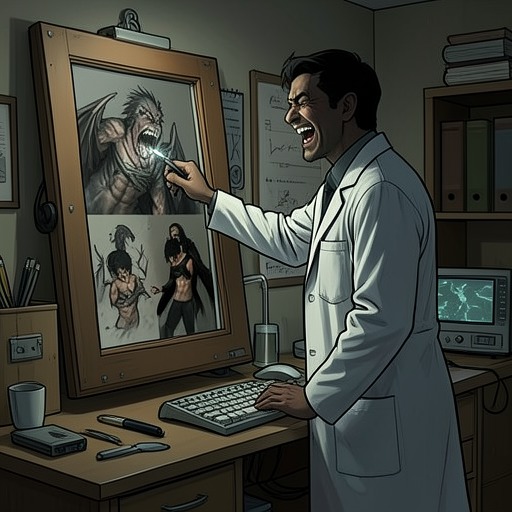
Demon makes the looking-glass while in a merry mood, intending its effects as an amusement. It reverses ordinary perception: beautiful landscapes become like boiled spinach, people appear hideous and grotesquely distorted, and a single freckle can seem to spread across the nose and mouth. Faces become so altered that they are unrecognizable; some figures seem to stand on their heads and have no bodies.
The mirror distorts moral perception as well as appearance. When a good or pious thought enters someone’s mind, the glass misrepresents it. Demon laughs at what he regards as his cunning invention, while the pupils of Demon's School repeat its wonders and claim that the mirror lets people see the world and humankind as they really are. That claim reverses the truth: the glass does not disclose reality but systematically disfigures it, encouraging its users to mistake distortion for insight.
Circulation and Shattering
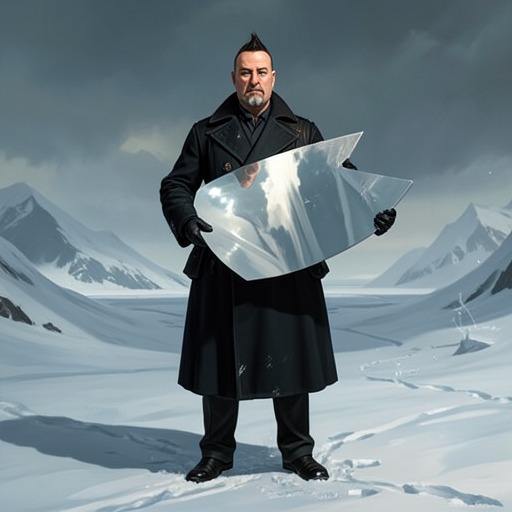
Demon’s pupils carry the glass everywhere. Eventually, every land and people has been viewed through it. Their ambition then turns upward: they want to fly with it to heaven and see the Angels. The higher they rise, the more slippery the glass becomes, until they can scarcely hold it. It slips from their hands, falls to earth, and breaks into millions of pieces.
The breakage is a reversal, but not a cure. The whole mirror had been a portable instrument of distortion; shattered, it becomes a multitude of smaller instruments scattered beyond anyone’s control. The pieces are not all alike in size: some are scarcely as large as a grain of sand, while others are large enough to serve as window-panes or to be made into spectacles. Even the apparently useless smallest fragments retain the original power. The object’s physical fragmentation therefore expands rather than ends its reach.
The Fragments’ Afterlife
A tiny fragment that enters someone’s eye can lodge there without the person knowing it. From then on, that person sees through a distorted medium, or sees only the worst side of what is before them. The fragment need not be noticed to be effective: its danger lies partly in how quietly it changes the terms of perception.
A fragment in the heart produces a different, more terrible consequence. The affected heart becomes cold like a lump of ice. Larger pieces impose distortion more openly: looking at friends through them would be grievous, and spectacles made from the glass prevent their wearers from seeing rightly or justly. The story thus gives the same material corruption several forms—an unnoticed speck in the eye, a coldness within the heart, and devices that make misjudgment habitual.
Demon laughs at the mischief the fragments cause, and pieces continue to float through the air. The shattered mirror remains active after the scene of its destruction: its power is dispersed into people’s bodies, their relationships, and their everyday ways of looking. The danger is not limited to a single encounter with the whole glass; it persists wherever a fragment can reach.
Later Optical Echoes
The story later returns to the problem of seeing through magnification when Gerda confronts the Snow Queen’s living snowflake guards in Finland. She remembers how large and beautiful snowflakes appeared through a burning-glass, but the snowflakes before her are genuinely larger, alive, and frightening. The scene distinguishes a magnified image from a real threat, while renewing the story’s concern with the unstable boundary between what is seen and what is there.
When Gerda prays, the steam of her breath takes the shape of Angels, who grow as they touch the earth and drive the snowflake guards back. This later episode does not undo the looking-glass’s damage; instead, it sets a different kind of vision and aid against the world of distortion. The original shattering consequently serves as more than an origin for a magical hazard: it establishes the story’s recurring contrast between appearances that mislead and forms of perception grounded in goodness and faith.